
What is alkaline water?
In straight scientific terms, alkaline water is “water capable of neutralizing acid introduced to the solution to the degree which its pH indicates.”
This question, what is alkaline water, is coming up more and more frequently as more and more people begin to hear of and investigate the benefits, pros, cons, and things to watch out for in alkaline water as a newly emerging basis for healthy living.


As time progresses, more and more studies have come out revealing the benefits of alkaline water and in particular highlighting the essential minerals which we need our everyday water to provide us with.
The necessity of minerals in the water we drink is a greatly overlooked fact and this is especially the case when it comes to alkaline water.
PubMed – Contribution of Drinking water to Mineral Nutrition in Humans
In this article we will specifically be looking just at “What is Alkaline Water?”, but there are 3 other attributes of water which should not be overlooked if you’re looking to receive all the benefits water has to give us.
4 Important Attributes of Water
Not all alkaline water provides everything in the list below so be sure to check out our How to Make Alkaline Water or Comparison Table (coming soon) page for more info.
In short these attributes including alkalinity are:
- Alkalinity of the Water
- Essential Minerals in the Water
- Negative ORP Value in the Water, Read More on our page, What is ORP & Redox Potential?
- Molecular Hydrogen (H2) in the Water, Read More on our page (coming soon)
Read on below to find out more, or to find out what exactly is alkalinity and how it applies to water, check out our What is Alkalinity? page.
What is Alkaline Water?
There is more than one way to answer the question, What is Alkaline Water?
To put it into straight scientific terms again, alkaline water is “water capable of neutralizing acid introduced to the solution to the degree which its pH indicates”.
The important question derived from the statement above is in the HOW does alkaline water do this?
The answer of course takes us back to chemistry class, however setting aside the chemical formulas and equations for a moment; what it takes to neutralize acid in a solution is for the H+ hydrogen ion within the solution to bond with negative ions and turn into a neutral molecule (H2O) from a free radical (H+).
The factor causing a solution to have acidity is the H+, hydrogen ion, also called hydroxide. The concentration of H+ in a solution will determine its acidity and this is measured in pH.
Find out more about this on our other page, pH of Water Explained.
So again, “What is Alkaline Water?”
Alkaline water is any water which is capable of neutralizing an amount of acid if added into the water.
How much acid it can neutralize will depend on its level of alkalinity.
The level of alkalinity is measured on the pH scale, and most precisely by determining the exact volume of acid required to be added to the water to reduce its pH to a level of 4.2, by definition.
Read more on how to measure alkalinity on our page, What is Alkalinity?.
So what is it about alkaline water that makes it alkaline?
In the most basic sense, it is the prevalence of the OH- and other negative ions in the water. These ions in water are capable of neutralizing the H+ ions contributing to acidity in the water.
Where do the negative ions in the water come from?
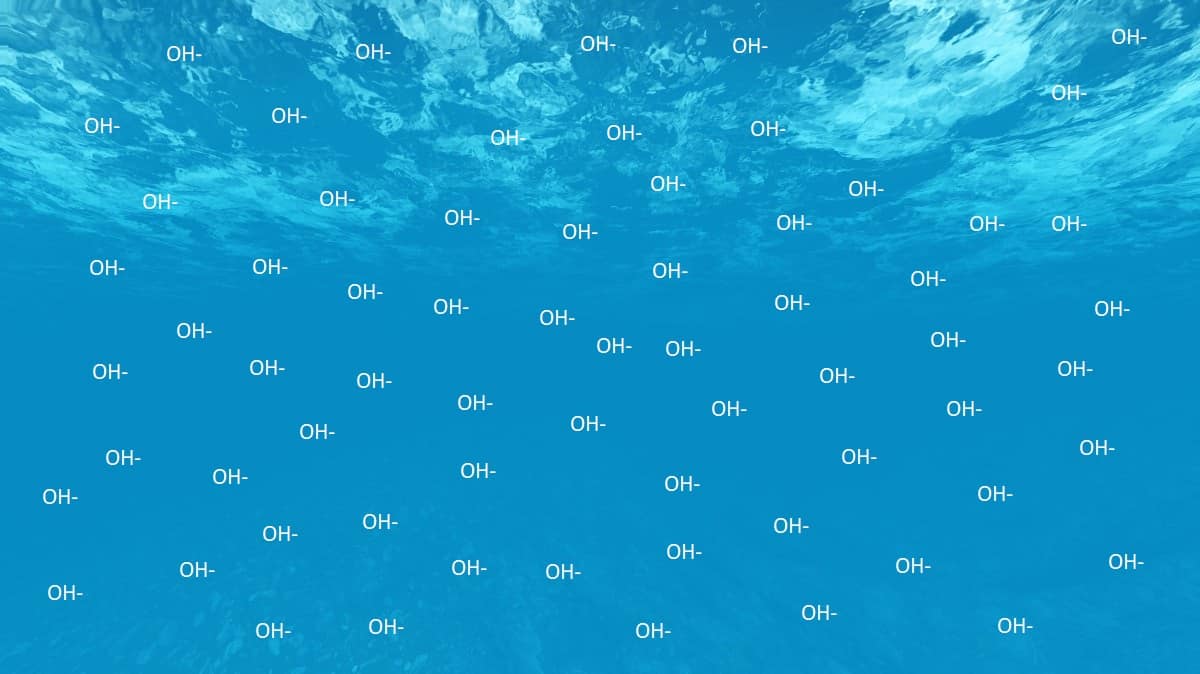
In nature, the negative ions in water come from the dissolved essential minerals in the water and the compound molecules they form with the water molecule H2O when in the water.
A prevalence of negative ions in the water specifically OH- ions can also be created via an electrical process called ionization.
To read more on what contributing factors are necessary for water to become alkaline vs acidic check out our page What is Alkalinity?
Alkaline Water pH
We’ve established that alkaline water means water with an excess of negative ions in solution.
But what does this mean for the pH of alkaline water?
The measure of the pH of water is based on the potential of H+, hydrogen ions within the water. This can be more easily thought of as the concentration in the water of the H+ hydrogen ions.
The higher the concentration of the H+ ions in solution, the lower the pH of the solution on a scale of 0-14.
This does seem counter intuitive, but it is in the method of how pH levels are expressed that a higher concentration is depicted as a lower value (lower pH levels mean more acidic).
Check out more info about pH on our page pH of Water Explained.
The excess of negative ions in the alkaline water will bond with the excess of H+ ions.
This will create neutral water and further to create water measured in the basic range or alkaline range.

_chart.svg)
We’ve stated before on other pages of this website,
You can have basic water that is not alkaline, but you cannot have alkaline water which is not basic.
Alkaline water is always in the pH range of greater than 7.0. A pH of 7 is exactly neutral, less than 7 is acidic and higher than 7 is basic or alkaline.
USGS Water Science School – pH Water Properties
Alkaline water always has a pH greater than 7 by its very composition. It has an excess of negative ions at the ready to neutralize any H+ ions, and this results in very low levels of free radical H+ ions in the water.
Again, the pH of water and any other substance is measured by the concentration of H+ ions.
This means that in alkaline water with an excess of negative ions to neutralize the H+ ions, the water will always will have a very low concentration of H+ ions and therefore a high, or basic/alkaline pH level.
It is possible to have a low concentration or neutral concentration of H+ hydrogen ions in water that is not alkaline and still have a high or neutral pH level.
Water in most cases however, will be alkaline if its’ pH is past the neutral point of 7. This is because a higher pH in water is almost always caused by the dissolved essential minerals from nature forming negative ions neutralizing the H+ ions and maintaining alkalinity.
Read more on pH and how it relates to water along with how to measure alkalinity on our page pH of Water Explained.
Alkaline vs Acidic Water
Water makes up 71 percent of the world’s surface, and is essential to life on the planet.
Could you take a guess at whether the majority of water is acidic or alkaline?


As it turns out, because ocean water accounts for 96.5% of the world’s water, the majority of the world’s water is alkaline, in the range of pH = 8.3.
USGS Water Science School – How much water is there on, in, and above the Earth?
If you’ve heard of the term ocean acidification, this is effectively the a process that turns all water acidic. The same process that will turn drinking water acidic, especially demineralized water, and what causes acid rain.
This is all caused by the CO2 in the atmosphere, and as CO2 concentration in the atmosphere increases so does the acid rain, ocean acidification and pure water acidification. This is caused by the formation of carbonic acid in the water, between the CO2 and H2O.
We discuss this in further depth on our Contributing Factors to Acidity section on pH of Water Explained.
The water consumed by wildlife and humans throughout history has been primarily alkaline.
This is due to the essential minerals prevalent in the freshwater found in wells, rivers, streams and lakes which when dissolved produce excess negative ion carbonates to neutralize any acidity in the water.
So is acidic water bad?
And is alkaline water good?
Modern day water as distributed to our homes by the city is typically filtered, but did you know that if the source water is alkaline, it is actually acidified before being delivered to you?
City water is only required to be at a “neutral” range of a pH between 6 and 7, so the water coming out of your tap, by city standards can be in the slightly acidic range of 6, below the neutral point of 7.
During the treatment process, oxidants, acids, and coagulants are added to our drinking water prior to final filtration to reduce alkalinity and destroy organic compounds (ie. algae etc.).
Positively charged coagulants like aluminum and iron salts are added to the water to oxidize the alkaline negative ions like OH- and other alkaline carbonates in the water created by the dissolved essential minerals.
This description of the conventional method of treating drinking water for consumption can be found on the EPA website,
EPA Website – “Conventional Treatment” (of drinking water)
This acidification is necessary to ensure that the drinking water is free of harmful organic compounds and other contaminants.
Learn more about ORP, the redox potential of water to find out how exactly reducing the alkalinity of water to acidic levels will provide safer drinking water on our page, What is ORP & Redox Potential?.
This is important to note, that in modern day society we have a need for acidic water (at least for household distribution purposes) as much as acidic water is unnatural when it comes to the water that our bodies need for longevity and to thrive.
Acidic water and alkaline water both have a place in modern society.

The important questions to ask ourselves is how is our water being treated or filtered, and do we want to consume water which is treated to destroy organic compounds and bacteria?
After all we humans are just another living organism composed of living cells ourselves.
The good news is with modern technology our water once treated and deemed safe to drink, can be re-alkalized & conditioned for a negative ORP value, and there are 2 main methods by which this can be done.
These methods are either via natural re-mineralization or electrical ionization which does not add any essential minerals to the water.
Important to note is that not all natural mineral ionizers will create a negative ORP antioxidant value for the water.
You can find more information on these 2 primary methods of water alkalinization on our page How to Make Alkaline Water, or check out our Comparison Table of alkaline water products (coming soon).